

Why Inner Learning Can Be More Meaningful Than Memorizing Knowledge
Memorizing knowledge can help us remember important information. A person may remember a definition, teaching, story, or principle perfectly. However, remembering something and understanding it are not always the same.
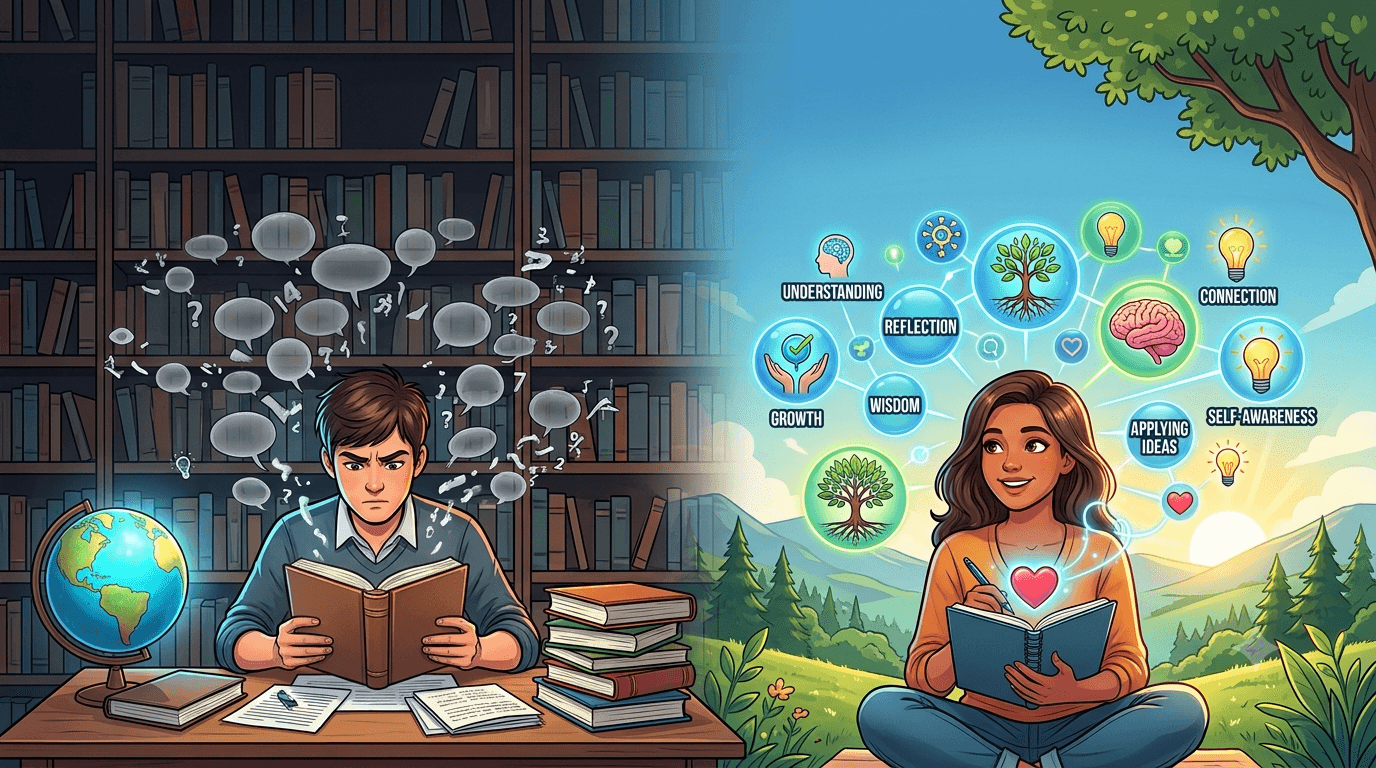
In a world where information is available almost instantly, learning is often associated with remembering facts, definitions, and ideas. Children study for examinations, adults learn new skills, and people regularly consume information through books, videos, websites, and social media. Knowledge is certainly valuable, but simply knowing more does not always mean understanding more.
There is another form of learning that goes deeper than memorization. Inner learning encourages a person to reflect, understand, observe, and discover meaning within themselves. Instead of simply asking, “What do I know?”, inner learning encourages questions such as, “What do I understand?”, “How does this affect the way I live?”, and “What can I learn about myself?”
This distinction is especially meaningful when exploring spiritual teachings. Timeless wisdom can become more relevant when it is not treated merely as information to remember, but as something to understand and experience.
Knowledge Gives Information, While Inner Learning Builds Understanding
Memorizing knowledge can help us remember important information. A person may remember a definition, teaching, story, or principle perfectly. However, remembering something and understanding it are not always the same.
For example, someone may know that patience is an important quality. They may be able to explain what patience means, but the deeper learning begins when they observe their own reactions during difficult situations.
Do they become impatient when things do not happen as expected? Can they pause before reacting? Can they understand another person's perspective?
This type of reflection transforms information into personal understanding.
Inner learning therefore moves beyond simply collecting knowledge. It encourages people to explore how an idea connects with their thoughts, emotions, actions, and everyday experiences.
The Importance of Understanding the Self
One of the most meaningful aspects of inner learning is self-understanding.
People often identify themselves through external circumstances. They may think of themselves in terms of their name, profession, relationships, possessions, achievements, or social roles. These aspects are part of everyday life, but they do not necessarily answer deeper questions about who we are.
Spiritual learning can encourage individuals to look beyond these external identities and reflect on the nature of the self.
Questions such as “Who am I?”, “What truly defines me?”, and “What remains beyond changing circumstances?” can encourage deeper reflection.
These questions do not always require immediate answers. The process of exploring them can itself become a meaningful form of learning.
Why Reflection Matters
Reflection gives learning a personal dimension.
When a person simply memorizes information, the learning may remain separate from everyday life. Reflection creates an opportunity to connect knowledge with experience.
For example, after learning about attachment, a person might begin observing how strongly they depend on possessions, opinions, expectations, or particular outcomes. Instead of merely remembering the concept, they begin noticing it in their own life.
This process can lead to greater awareness.
Reflection does not necessarily mean withdrawing from everyday responsibilities. It can happen during ordinary moments—while speaking with family members, making decisions, facing disappointment, or responding to challenges.
Stories Can Make Inner Learning Easier
Spiritual ideas can sometimes appear complex when presented only through definitions or theoretical explanations. Stories can make these ideas easier to explore.
A meaningful story can introduce a situation, a challenge, a choice, or a realization that encourages readers to think about their own experiences.
For children especially, storytelling can provide a natural way to explore deeper ideas. Instead of presenting a lesson as something they must memorize, a story can invite them to ask questions.
What did the character learn?
Why did the character make that decision?
Could the situation have been handled differently?
What does the story make us think about in our own lives?
Such questions transform passive learning into active reflection.
Making Spiritual Learning Relevant to Everyday Life
Inner learning becomes meaningful when it connects with daily experiences.
Spiritual teachings may discuss concepts such as awareness, karma, conduct, attachment, and liberation. These ideas can appear distant if they are treated only as subjects of study.
However, they can become more relatable when people consider how they connect with everyday life.
For instance, a discussion about right conduct can encourage someone to think about how they speak to others. Learning about attachment can encourage reflection on expectations and possessions. Learning about awareness can encourage someone to observe their thoughts and reactions more carefully.
In this way, spiritual learning becomes something that can be contemplated and applied rather than simply remembered.
Encouraging Children to Think Rather Than Simply Remember
Children naturally ask questions. Their curiosity can become an important part of meaningful learning.
When spiritual ideas are introduced through stories, conversations, and examples, children can be encouraged to think for themselves rather than simply repeat predetermined answers.
Parents can ask open-ended questions after sharing a story.
“What would you have done?”
“Why do you think the character reacted that way?”
“What did the character discover?”
“Have you ever experienced something similar?”
These conversations allow children to develop their own understanding.
The goal is not to force children to reach a particular conclusion. Instead, it is to create an environment where curiosity, reflection, and thoughtful discussion are encouraged.
Learning That Connects Different Generations
Inner learning can also create meaningful conversations between generations.
Parents, grandparents, and children may have very different experiences, but questions about life, identity, values, and understanding can create common ground.
A spiritual story can become the starting point for a family conversation. Different family members may interpret the same story differently, and that difference can make the discussion even more valuable.
Older family members can share their experiences, while younger members can contribute fresh questions and perspectives.
This creates learning that is shared rather than limited to a classroom or textbook.
From Information to Transformation
The deeper purpose of learning is not always to know more. Sometimes it is to see differently.
A person may read many books about compassion without becoming more compassionate. They may study patience without becoming patient. They may learn about self-awareness without regularly observing their own thoughts.
Inner learning creates an opportunity for knowledge to influence understanding and conduct.
This does not happen instantly. It is a gradual process of observing, questioning, reflecting, and applying what has been understood.
When learning begins to influence the way a person thinks and behaves, it becomes more than information. It becomes part of personal growth.
Creating Space for Inner Learning
Modern life can be filled with constant information and distractions. People move quickly from one task to another, leaving little time for reflection.
Creating even small moments of quiet can make a difference.
Reading a meaningful story, discussing an idea with family, spending a few moments reflecting on an experience, or simply observing one's thoughts can provide opportunities for inner learning.
The objective is not to stop acquiring knowledge. Knowledge remains important. The goal is to balance external learning with deeper internal understanding.
Conclusion
Knowledge and inner learning are not opposites. Knowledge provides valuable information, while inner learning encourages us to understand what that information means for our lives.
Memorization can help us remember a teaching, but reflection can help us discover its significance. A story can introduce an idea, but personal observation can help us understand it more deeply.
For families and younger generations, this approach can make spiritual learning more engaging and meaningful. Through stories, questions, conversations, and reflection, timeless teachings can become connected with everyday experiences.
Ultimately, inner learning is about looking beyond what we know and exploring what we truly understand. It encourages curiosity about the self, awareness of our thoughts and actions, and a deeper appreciation of the wisdom that can guide our journey within.